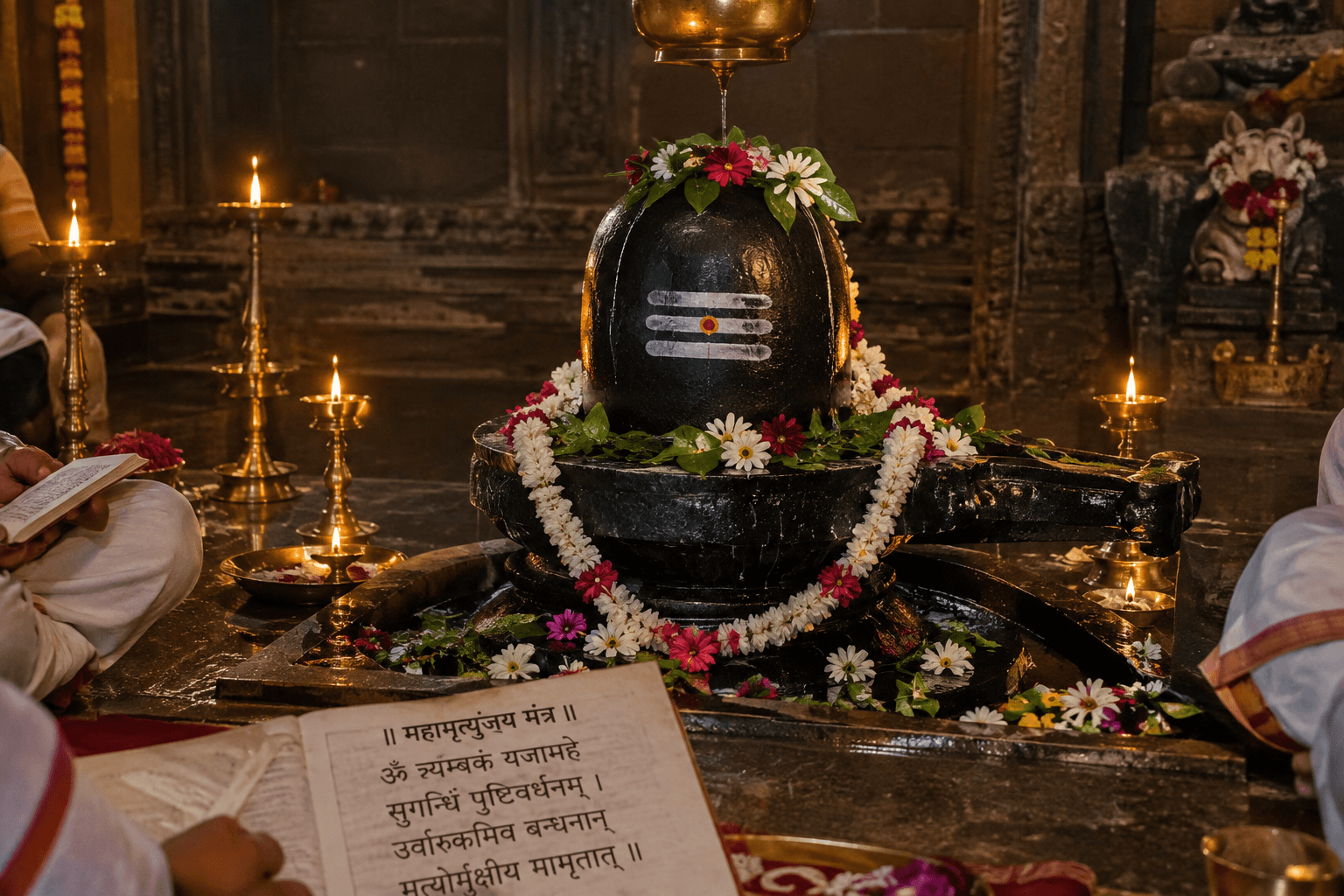
A sacred Shiva lingam adorned with flowers, sacred markings, and garlands, while devotees chant the Maha Mrityunjaya Mantra amid glowing lamps and divine temple ambience.
Eleven thousand recitations of the Mahamrityunjaya mantra, performed with the count fixed at the sankalpa and preceded by Shiva puja.
The eleven-thousand japa completed with a havan, the oblations offered on the same mantra at the prescribed fraction of the japa count.
Twenty-one thousand recitations, carried across the sittings the count requires, with Shiva puja and abhisheka at the opening of the observance.
Fifty-one thousand recitations completed with a homa on the same mantra. An extended observance, performed across several sittings and closed with purnahuti.
The full classical anushthan at the count the tradition most often names for this mantra, carried through to completion with a closing havan and purnahuti.
The Mahamrityunjaya is a single verse of the Rigveda (7.59.12) addressed to Tryambaka, the three-eyed, identified in the Shaiva tradition with Shiva. It asks to be released as a cucumber is released from its stem — from bondage, not from life — and is recited in the tradition for longevity, healing and freedom from the fear of untimely death. Japa of this mantra is counted. The packages below state their counts plainly, from 11,000 up to the classical 1,25,000-recitation anushthan, and where a havan is included the oblations are offered on the same mantra at the prescribed fraction of the japa count.
A counted japa (purascharana) is a defined observance rather than an open-ended one: the count is fixed at the sankalpa, kept through the sittings, and completed with a havan offered on the same mantra. The 1,25,000 count is the one most often named in the tradition for the Mahamrityunjaya, which is why it stands as the fullest anushthan offered here.
Traditionally recited for longevity, healing and freedom from the fear of untimely death.
Commonly offered during illness, convalescence or a period of difficulty.
Undertaken on behalf of a family member who cannot perform the japa themselves.
Taken up as a counted anushthan when the tradition's fuller observance is wanted.
Japa of the Mahamrityunjaya mantra to the count named on the package.
Havan on the same mantra where the package includes one.
Preparatory Ganapati puja and Shiva puja.
Sankalpa taken in the devotee's name, gotra and stated intention.
Photographs of the ritual shared with you afterwards.
Prasad couriered to you once the ritual is complete.
Sankalpa in your name, gotra and stated intention, with the japa count fixed.
Ganapati puja, purification and kalash sthapana.
Shiva puja and abhisheka of the linga.
Japa of the Mahamrityunjaya mantra to the sankalpa count.
Havan on the same mantra where included, then purnahuti, aarti and prasad.
The larger counts are completed across several sittings; the schedule is confirmed with you before the anushthan begins.
The japa can be performed on behalf of someone who is unwell — give their name and gotra in Special Requests.
Share your name, gotra (if known) and the purpose of the ritual in Special Requests when booking; the sankalpa is made from these.
Our team confirms the date, the time and any remaining details with you by phone or WhatsApp within 24 hours.
Timings may shift on festival days and on other special occasions in the temple calendar.
Choose a package, share your details, and our team will confirm your booking within 24 hours.
Choose a Package