
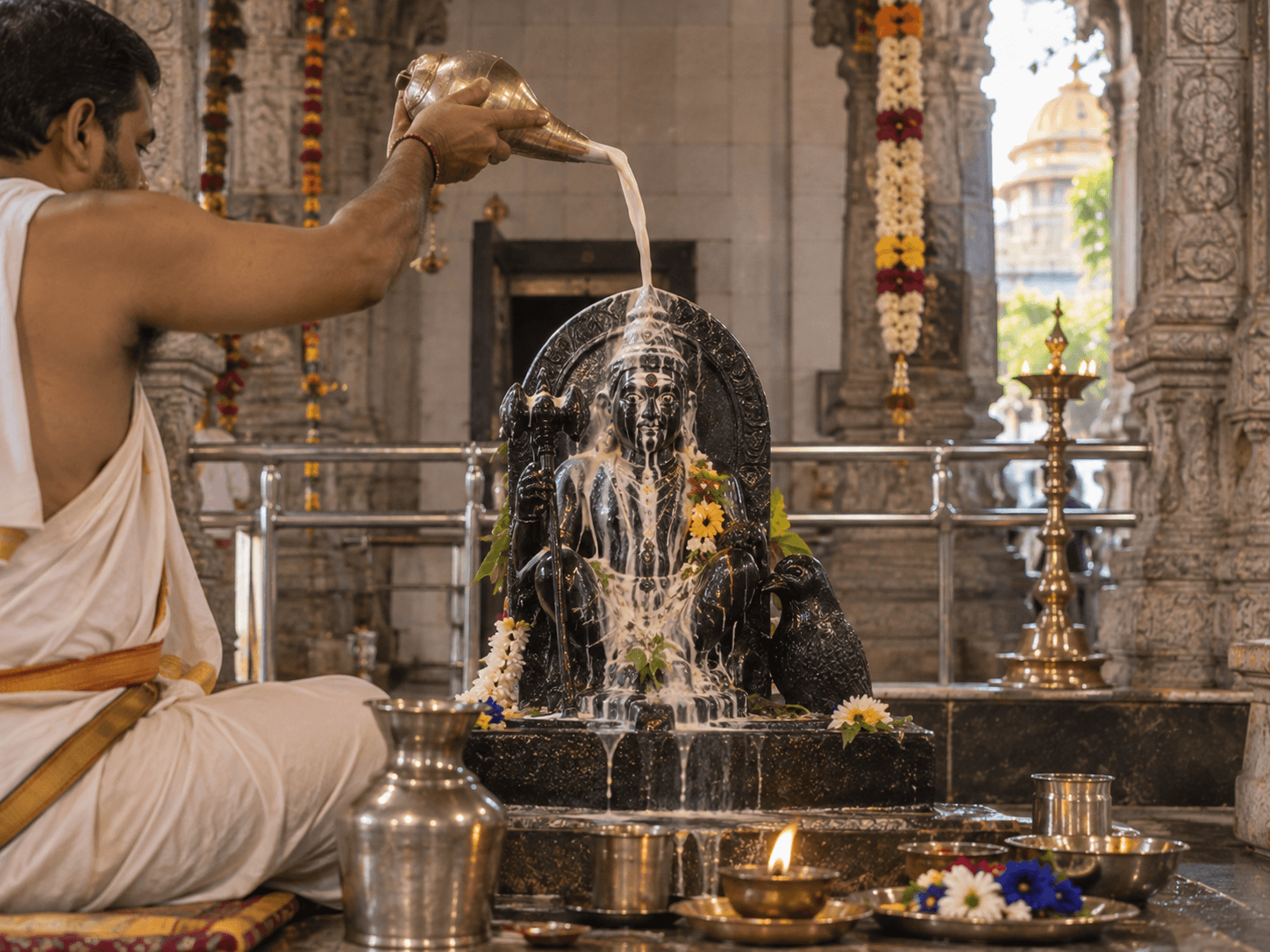
Ritual bathing of the nine grahas, each with the substances the tradition assigns to it, followed by adornment and archana.
 ₹5,100
A focused worship dedicated to one chosen Graha, combining traditional Abhishekam and sacred fire offerings with mantras and prayers, seeking peace, balance, auspiciousness, and harmony in matters associated with the selected Graha.
 ₹7,500
A sacred worship dedicated to Shani through traditional Abhishekam, mantras, prayers, and sacred fire offerings, seeking peace, patience, stability, protection, and harmony during challenging periods.
 3 ACHARYAS₹15,000
A sacred worship of the nine Navagrahas performed by 3 Acharyas, combining traditional Puja, mantras, prayers, and sacred fire offerings, seeking peace, balance, auspiciousness, and harmony during important phases of life.
 11 ACHARYAS₹51,000
A sacred Anushthan dedicated to the nine Navagrahas, performed by 11 Acharyas with traditional Abhishekam, mantras, prayers, and sacred fire offerings, seeking peace, balance, auspiciousness, and harmony.
Navagraha Abhishekam & Homam is a traditional worship dedicated to the nine Navagrahas — Surya (Sun), Chandra (Moon), Mangal (Mars), Budha (Mercury), Guru (Jupiter), Shukra (Venus), Shani (Saturn), Rahu (North Node), and Ketu (South Node). In Hindu tradition, the Navagrahas hold an important place in Jyotisha and sacred worship. Each Graha has its own traditional identity, mantra, colour, offerings, and associated forms of worship. The Matsya Purana gives a detailed account of the nine Grahas and describes their traditional forms, placement, colours, offerings, mantras, and methods of Navagraha Shanti. The Agni Purana also preserves a specific Navagraha fire-offering procedure with individual mantras, sacred woods, food offerings, ghee, and other prescribed materials. The Abhishekam portion of the worship is performed with sanctified substances and prayers as part of the devotional honouring of the Navagrahas. The Homam then offers prescribed materials into the sacred fire while the respective Graha mantras are recited. Traditional texts describe offerings made separately for the different Grahas, reflecting their individual ritual identities. This worship may be performed with a specific Sankalp, such as seeking peace and stability during an important planetary period, or as a general devotional offering to the Navagrahas. Devotees may choose Navagraha Abhishekam & Homam for peace, harmony, stability, patience, clarity, auspiciousness, spiritual strength, and divine support during important or challenging phases of life. The exact mantras, Abhishekam substances, offerings, number of Ahutis, and sequence of the ceremony may vary according to the selected Anushthan and the tradition followed by the Acharyas.
Navagraha Abhishekam & Homam brings together two important forms of traditional worship: respectful offering and sacred fire worship.
The Matsya Purana describes the Navagrahas individually, including their traditional forms, colours, positions, offerings, and mantras. It also describes a Navagraha Shanti procedure in which the Grahas are worshipped individually and sacred offerings are made into fire with their respective mantras.
The Agni Purana preserves a dedicated chapter on Navagraha fire offerings. It specifies different sacred woods, offerings, food preparations, ghee, honey and curd, along with individual mantras and prescribed numbers of offerings for the Grahas.
The tradition therefore treats the nine Grahas individually rather than as a single undifferentiated force. Surya, Chandra, Mangal, Budha, Guru, Shukra, Shani, Rahu, and Ketu each have their own ritual identity and prescribed forms of honouring.
Abhishekam represents respectful worship through sacred bathing and offerings, while Homam presents prescribed offerings into Agni along with mantra recitation. Together, the ceremony provides a structured devotional practice through which devotees can establish a sincere Sankalp and pray for peace, stability, auspiciousness, clarity, and divine support.
The purpose of the worship is not presented as a guarantee of a particular worldly result. Rather, devotees approach the Navagrahas with reverence, prayer, humility, and faith while seeking harmony during important phases of life.
The exact Abhishekam materials, mantras, Ahuti count, offerings, and ritual sequence may differ according to the selected service and the tradition followed by the Acharyas.
Peace & Harmony – Seek greater peace and balance through traditional Navagraha worship.
Stability During Important Phases – Offer prayers during significant or challenging periods of life.
Clarity & Inner Strength – Seek guidance, steadiness, patience, and spiritual strength.
Auspiciousness – Begin important phases of life with sincere prayer to the Navagrahas.
Sankalp-Based Worship – Dedicate the ceremony to a specific personal, family, or life intention.
Divine Support – Approach the nine Grahas with devotion, humility, and faith.
Traditional Navagraha Abhishekam
Individual worship of the nine Navagrahas
Recitation of traditional Navagraha mantras
Traditional offerings associated with the Grahas
Navagraha Homam with sacred offerings
Personal Sankalp in the devotee's name
Purnahuti and concluding prayers
Aarti and blessings
Prasad after completion of the ceremony
Preparation – The worship area, Navagraha arrangements, Kalasha, sacred fire, and required ritual materials are prepared according to the selected tradition.
Sankalp – The devotee's name, family details, Gotra if known, and prayer intention are taken for the Sankalp.
Invocation of the Navagrahas – Surya, Chandra, Mangal, Budha, Guru, Shukra, Shani, Rahu, and Ketu are respectfully invoked for the worship.
Navagraha Abhishekam – The prescribed Abhishekam is performed with sanctified substances and traditional prayers as part of the worship of the Navagrahas.
Navagraha Puja & Mantra Recitation – Each Graha is respectfully worshipped with its prescribed prayers, offerings, flowers, fragrance, and other traditional upacharas according to the selected ritual method.
Navagraha Homam – Sacred offerings are placed into the consecrated fire while the respective Graha mantras are recited. Traditional texts describe individual offerings and sacred materials for the nine Grahas.
Purnahuti, Aarti & Blessings – The ceremony concludes with Purnahuti, prayers, Aarti, blessings, and Prasad.
If you have your birth details or a horoscope, share them in Special Requests — the acharya uses them to set the emphasis of the sankalpa.
You may attend in person or have the ritual performed on your behalf.
Share your name, gotra (if known) and the purpose of the ritual in Special Requests when booking; the sankalpa is made from these.
Our team confirms the date, the time and any remaining details with you by phone or WhatsApp within 24 hours.
Timings may shift on festival days and on other special occasions in the temple calendar.
Choose a package, share your details, and our team will confirm your booking within 24 hours.
Choose a Package