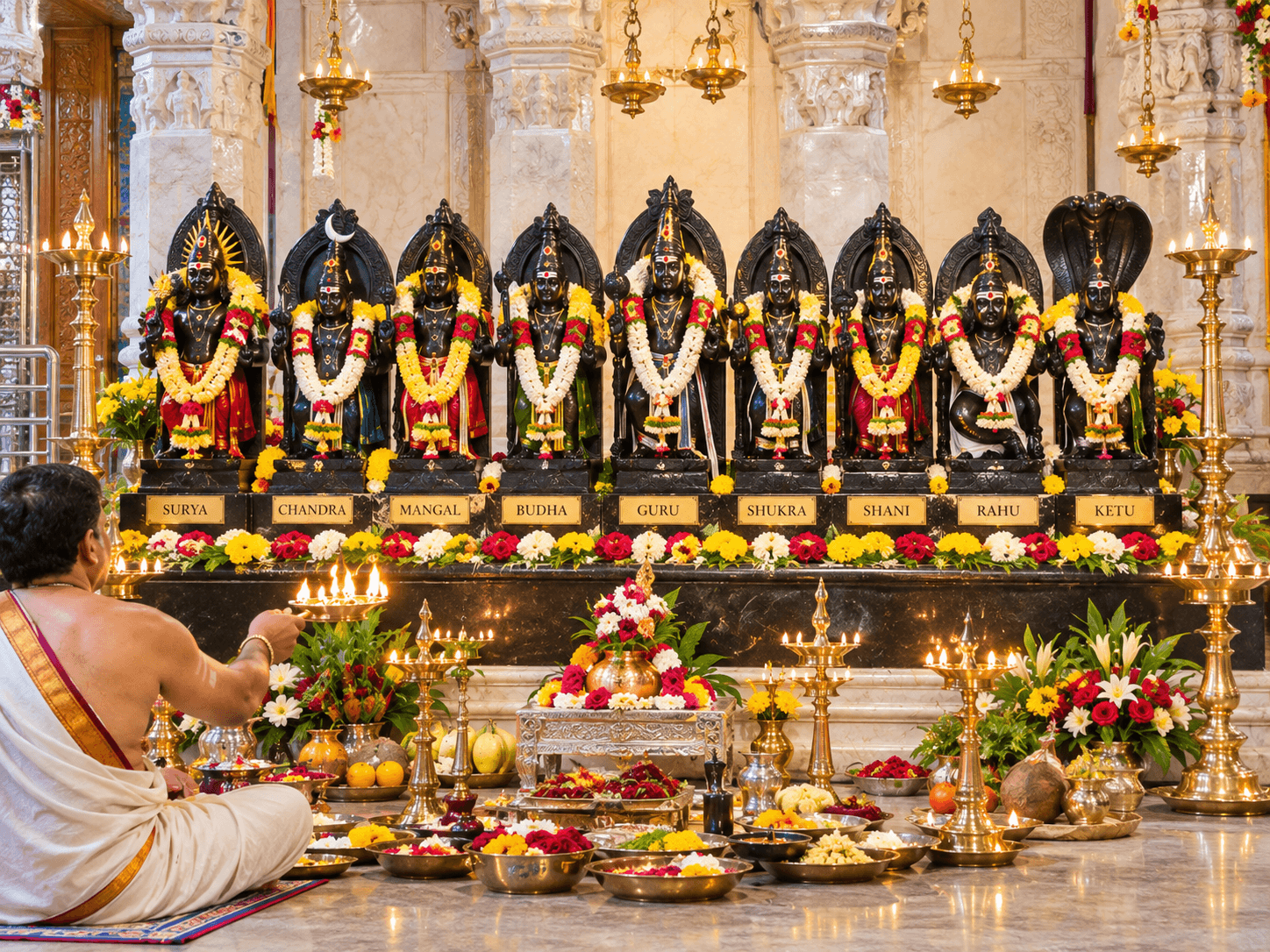
Propitiation of the nine grahas together, each invoked in its own place with its own mantra, grain and offering. The standard form of graha shanti.
 ₹5,100
A sacred worship of the nine Navagrahas through traditional mantras, prayers, and offerings, performed to seek peace, harmony, auspiciousness, stability, and divine support during important phases of life.
 ₹7,500
A sacred worship of the nine Navagrahas through traditional mantras, prayers, and offerings, performed with a dedicated Sankalp to seek peace, balance, auspiciousness, and relief from challenging planetary influences
 1 ACHARYA, 1008 NAAM₹11,000
A sacred worship of the nine Navagrahas through the recitation of 1,008 divine names and traditional Til offerings, seeking blessings for peace, harmony, auspiciousness, stability, and relief from challenging planetary influences.
 ₹2,500
A focused worship dedicated to one specific Graha through traditional mantras, prayers, and offerings, seeking peace, balance, auspiciousness, and support in matters associated with the chosen Graha.
Navagraha Puja is a traditional worship of the nine Navagrahas — Surya (Sun), Chandra (Moon), Mangal (Mars), Budha (Mercury), Guru (Jupiter), Shukra (Venus), Shani (Saturn), Rahu (North Node), and Ketu (South Node). In Hindu tradition, these nine Grahas hold an important place in Jyotisha and ritual worship, and each is honoured through its own traditional mantras, offerings, prayers, and forms of worship. The purpose of Navagraha Puja is to respectfully honour all nine Grahas and seek peace, harmony, auspiciousness, stability, and divine support. The worship may be performed as a general devotional practice or in connection with planetary influences identified through traditional Jyotisha. The Matsya Purana describes the nine Grahas and preserves traditional practices for their worship and Shanti. The Agni Purana also provides detailed guidance concerning Navagraha worship, including their respective mantras, offerings, and ritual practices. These traditions establish Navagraha worship as a structured form of devotional practice rather than simply a modern astrological remedy. During the Puja, each Graha is respectfully invoked and worshipped with prescribed prayers and offerings. Depending on the selected service, the ceremony may also include specific Archana, Abhishekam, mantra recitation, or sacred fire offerings. Navagraha Puja may be chosen for a specific Sankalp, during an important phase of life, before a significant undertaking, or simply as an offering of devotion to the nine Grahas. The exact mantras, offerings, and sequence of worship may vary according to the selected service and the traditional method followed by the Acharyas.The Nine Grahas Surya – Associated with vitality, authority, confidence, and illumination. Chandra – Associated with the mind, emotions, nourishment, and inner calm. Mangal – Associated with courage, strength, energy, and determination. Budha – Associated with intelligence, learning, communication, and understanding. Guru – Associated with wisdom, knowledge, guidance, and spiritual learning. Shukra – Associated with beauty, refinement, relationships, and prosperity. Shani – Associated with discipline, patience, responsibility, and perseverance. Rahu – Associated with worldly experiences, ambition, change, and unexpected circumstances. Ketu – Associated with detachment, spiritual insight, introspection, and transformation.
Navagraha Puja represents the traditional Hindu practice of respectfully honouring the nine Grahas as part of the wider system of Jyotisha and sacred worship. The Grahas are not worshipped merely as physical planets; within the traditional understanding, they are approached as cosmic forces connected with time, order, and different aspects of human experience.
Each Graha has its own traditional identity, mantra, offerings, direction, colour, and associated forms of worship. During Navagraha Puja, these distinct forms are honoured individually while maintaining the understanding that all nine form one complete group.
The Matsya Purana gives detailed descriptions of the nine Grahas and their traditional worship, including their forms, mantras, offerings, and methods of Shanti. The Agni Purana also preserves practices for Navagraha worship and gives specific ritual details associated with the individual Grahas.
A significant aspect of this tradition is respect and harmony. Devotees approach the Navagrahas with humility, make the prescribed offerings, recite their mantras, and establish a sincere Sankalp. The purpose is not simply to seek a particular material outcome, but to perform a traditional act of worship while praying for peace, stability, clarity, auspiciousness, and divine support.
Navagraha Puja may therefore be performed as part of regular devotion or in connection with an important planetary period, life transition, or specific Jyotisha guidance. The exact mantras, offerings, and sequence are determined according to the selected form of worship and the ritual tradition followed by the Acharyas.
Seek the Blessings of All Nine Grahas – Offer respectful prayers to the complete Navagraha.
Peace & Balance – Pray for greater harmony and steadiness during challenging periods.
Freedom from Obstacles – Seek support while navigating difficulties associated with planetary influences.
Clarity & Strength – Pray for wisdom, patience, courage, and thoughtful action.
Auspicious Beginnings – Suitable before important life events and new undertakings.
Family Well-being – Dedicate the worship to peace, harmony, and well-being within the family.
Traditional Navagraha Puja performed by Acharyas
Worship of all nine grahas
Traditional mantras and prayers for each graha
Graha-specific offerings according to the selected ritual
Your name, Gotra, and prayer intention included in the Sankalp
Sacred offerings and concluding prayers
Homam when included in the selected service
Prasad according to the chosen service
Preparation – The Puja space and traditional materials for the nine grahas are prepared according to the prescribed ritual.
Sankalp – Your name, Gotra, family details, and prayer intention are included in the Sankalp for the worship.
Navagraha Invocation – The Acharyas respectfully invoke the nine grahas and begin their individual worship.
Individual Graha Worship – Surya, Chandra, Mangal, Budha, Guru, Shukra, Shani, Rahu, and Ketu are worshipped individually with their prescribed mantras and offerings.
Navagraha Shanti – Traditional prayers and offerings are performed while seeking peace and harmony in relation to the nine grahas.
Homam & Final Prayers – When included in the selected service, prescribed offerings are placed into the sacred fire with the relevant mantras. The ceremony concludes with prayers, Aarti, and Prasad.
Choose a package, share your details, and our team will confirm your booking within 24 hours.
Choose a Package