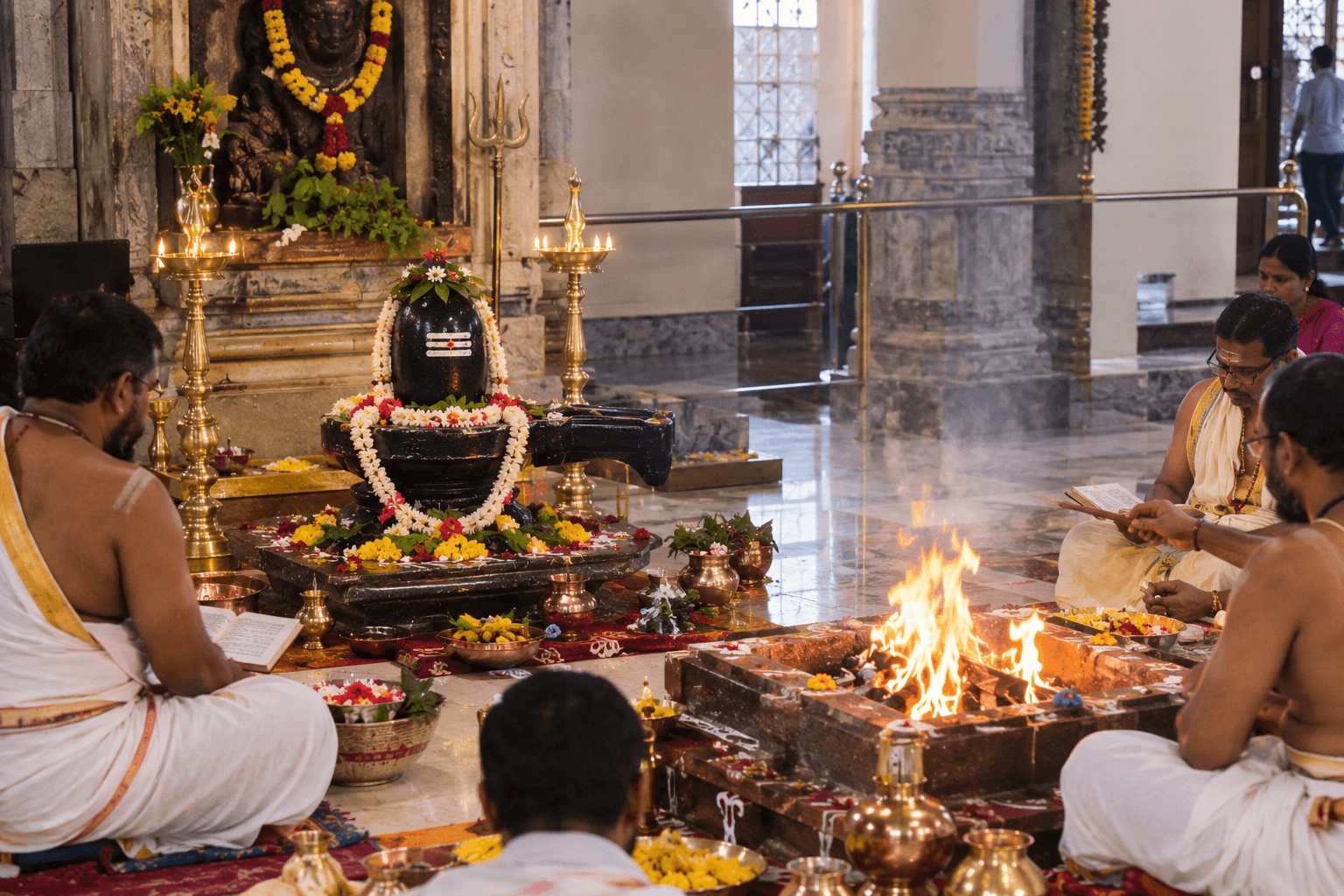
Puja of the Shivalinga completed with a fire offering — homa or yajna — on the mantras used in the puja, from a single sitting through to a full Rudra Yajna anushthan.
Puja and abhisheka of the Shivalinga followed by a homa on the Shiva mantras, in a single sitting closed with purnahuti and aarti.
The extended form: a fuller linga puja followed by a yajna with a longer sequence of oblations, sustained through the recitation rather than offered only at the close.
Rudrabhisheka with the Rudram recited over the bathing, followed by a homa in which the oblations are offered on the Rudram itself.
Shiva puja with Mahamrityunjaya japa, completed by a homa on the same mantra. Commonly offered as a sankalpa for health and protection.
An extended Rudra Yajna carried across more than one session: the Rudram sustained through the observance, abhisheka renewed, and the oblations offered throughout to a closing purnahuti.
Here the linga is worshipped and the worship is then carried into the fire. After the abhisheka and the upacharas, agni is established and oblations are offered on the same mantras — the Rudram, the Mahamrityunjaya, or the Shiva mantras used in the puja, depending on the form. This pairing is the ordinary shape of a complete Shaiva observance rather than an addition to it: the Rudram's own Vedic setting is a fire rite, and offering on it returns the recitation to the context it belongs in.
Puja addresses the deity present in the linga; homa offers into the fire on the same mantras. The tradition treats the two as one sequence, and a Rudra Yajna is simply that sequence held at length, with the recitation sustained and the oblations offered throughout rather than only at the close.
The traditional way to complete an extended Shaiva observance.
Undertaken at the close of an anushthan, or as an annual family rite.
Customarily offered in Shravana, on Mahashivaratri and at the start of a new undertaking.
Taken up as a sankalpa for the health and protection of a household.
Puja and abhisheka of the Shivalinga with the prescribed upacharas.
Homa or yajna with oblations on the mantras used in the puja.
Purnahuti and the concluding offerings.
Sankalpa taken in the devotee's name, gotra and stated intention.
Photographs of the ritual shared with you afterwards.
Prasad couriered to you once the ritual is complete.
Sankalpa in your name, gotra and stated intention.
Ganapati puja, purification and kalash sthapana.
Abhisheka and puja of the Shivalinga with the prescribed upacharas.
Agni sthapana, and the homa or yajna on the same mantras.
Purnahuti, aarti and distribution of prasad.
A fire rite is performed at the Samiti's own altar; the timing is set with you when the booking is confirmed.
You may attend in person or have the ritual performed on your behalf.
Share your name, gotra (if known) and the purpose of the ritual in Special Requests when booking; the sankalpa is made from these.
Our team confirms the date, the time and any remaining details with you by phone or WhatsApp within 24 hours.
Timings may shift on festival days and on other special occasions in the temple calendar.
Choose a package, share your details, and our team will confirm your booking within 24 hours.
Choose a Package